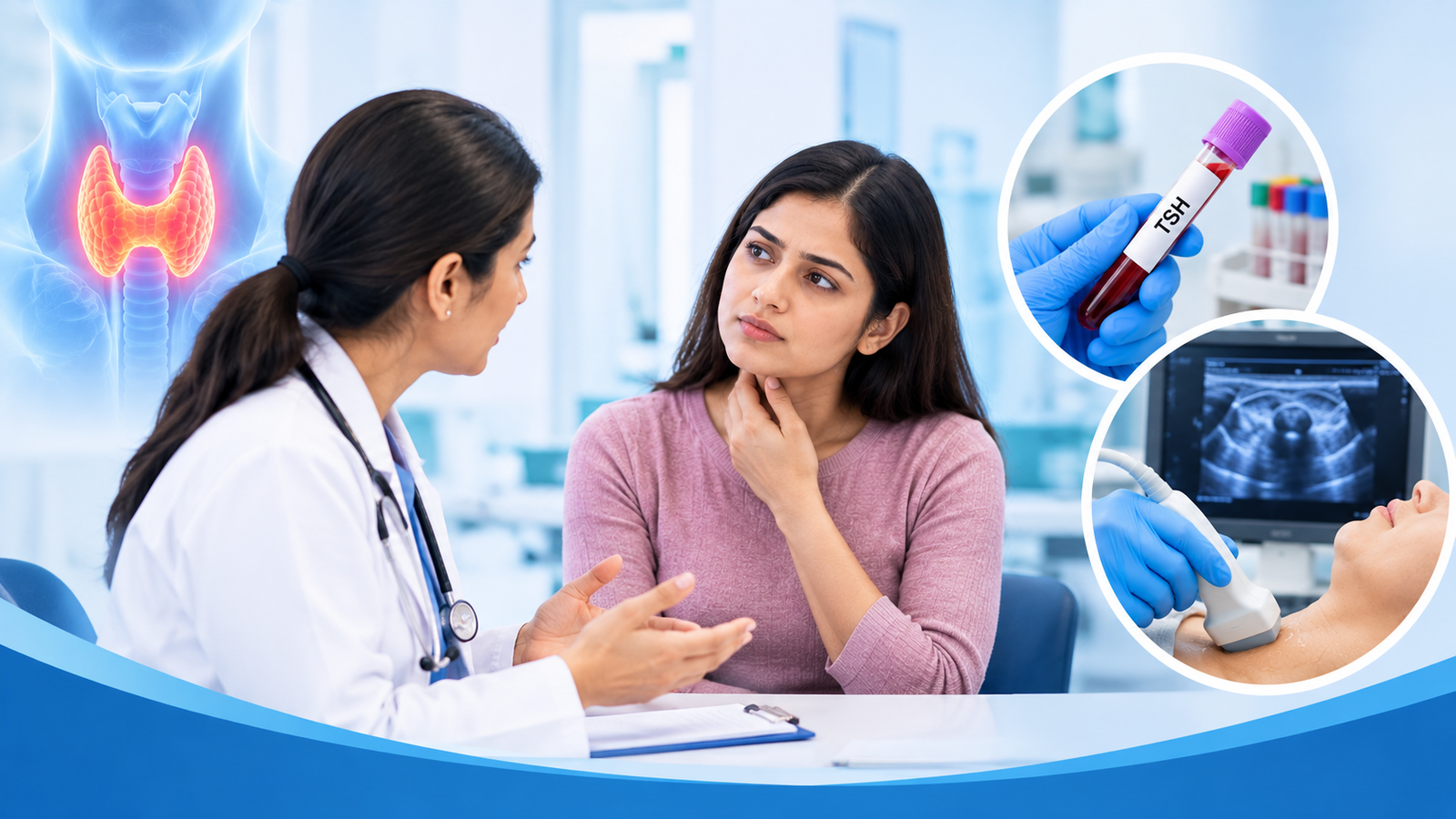
A TSH blood test checks how well your thyroid is working. A thyroid ultrasound checks what it physically looks like. They answer completely different questions, which is why a doctor sometimes orders one, sometimes the other, and sometimes both. If you have been advised to have a thyroid test at Indore clinics, and you are not sure which one applies to you, the short answer is this: symptoms point to blood work, a visible or felt lump points to a scan.
The Core Difference in One Line
- Blood test: measures function. Is your thyroid producing the right amount of hormone?
- Ultrasound: measures structure. Is the gland the right size and shape, and are there nodules or growths?
A perfectly normal-looking thyroid on a scan can still be underactive. A gland with a small nodule can produce hormone perfectly well. Neither test replaces the other, which is the single most useful thing to understand before your appointment.
When a Blood Test Is the Right Starting Point
If your concern is how you feel rather than something you can touch, blood work comes first. Doctors typically start here when you report:
- Unexplained fatigue that does not improve with rest
- Weight gain or weight loss without a change in diet
- Feeling cold when others are comfortable, or unusually heat sensitive
- Irregular or heavier periods
- Hair thinning or dry, brittle hair
- A racing heartbeat, tremor, or unusual anxiety
- Constipation or unusually frequent bowel movements
Hair fall in particular sends a lot of people looking for answers, and thyroid is only one of several possible causes. Our guide to hair fall in women covers how thyroid, PCOS, and low iron each show up differently.
What TSH, T3 and T4 Actually Measure
Most doctors start with TSH alone, then add the others if the result is off. Here is what each one tells you:
- TSH (Thyroid Stimulating Hormone): produced by the pituitary gland, not the thyroid. High TSH usually means an underactive thyroid, low TSH usually means an overactive one. It is the most sensitive early indicator, which is why it is the standard first test.
- T4 (Thyroxine): the main hormone your thyroid produces. Confirms and quantifies what TSH suggests.
- T3 (Triiodothyronine): the more active form. Particularly useful when hyperthyroidism is suspected.
A full TSH T3 T4 thyroid test Indo0re labs offer as a single thyroid profile gives your doctor all three in one sample, which saves a second visit if the first result needs follow-up. No fasting is required for a standard thyroid profile, though a morning sample is often preferred since TSH naturally fluctuates through the day.
Tired all the time and not sure why? A thyroid profile takes one blood sample and rules it in or out.
When a Thyroid Ultrasound Is Needed Instead
Imaging comes into the picture when there is something physical to look at. Your doctor is likely to order a scan if:
- You or your doctor can feel a lump or nodule in the front of your neck
- There is visible swelling or a goitre
- You have difficulty swallowing or a persistent feeling of tightness in the throat
- A nodule was found incidentally on another scan, which happens often
- You have a family history of thyroid cancer or previous neck radiation
- An existing nodule needs monitoring for changes in size over time
An ultrasound shows the size of each lobe, how many nodules are present, whether they are solid or fluid filled, and whether any features look concerning enough to investigate further. It uses no radiation and takes around 15 minutes.
When You Need Both
This is more common than people expect. A typical sequence looks like this:
- You report fatigue and weight gain, so your doctor orders a thyroid profile
- TSH comes back high, confirming an underactive thyroid
- During examination, your doctor also feels a nodule
- An ultrasound is added to check the structure, since blood work cannot see nodules
- If a nodule has concerning features, an FNAC is advised to sample its cells
That last step is where a diagnostic centre that handles both imaging and pathology saves real time, since the scan, the aspiration, and the lab reporting can happen without arranging three separate appointments in three places.
What About Thyroid Nodules?
Nodules are extremely common, and the vast majority are benign. Ultrasound is what tells your doctor whether a nodule needs anything further, based on its size, its internal features, and its blood flow pattern.
If a nodule does look worth investigating, the next step is usually an FNAC test, a quick procedure using a very thin needle to collect cells for examination. It is not a sign that something is wrong, it is how doctors confirm that nothing is.
Felt a lump in your neck? An ultrasound can tell you what it is, usually in a single visit.
Getting Both Done in One Place
If you have searched for a pathology lab near me in Indore and separately wondered where to get the scan done, the practical answer is to find somewhere that does both. Apoorva Diagnostic Centre has been running imaging and lab work in the city for over 35 years, covering thyroid profiles, thyroid ultrasound, and FNAC for nodules across our Vijay Nagar and Sapna Sangeeta branches.
As a full pathology lab in Indore alongside a working imaging department, we can usually complete a prescription that calls for both blood work and a scan without sending you somewhere else halfway through.
Frequently Asked Questions
1. Do I need to fast before a thyroid test?
No, fasting is not required for a standard thyroid profile. A morning sample is often preferred because TSH levels naturally shift through the day, but you can eat normally beforehand.
2. Can a thyroid ultrasound detect hypothyroidism?
No. An ultrasound shows the structure of the gland, not how it is functioning. Hypothyroidism is diagnosed through blood work, usually starting with TSH.
3. Is TSH alone enough, or do I need T3 and T4 as well?
TSH alone is often enough for initial screening. If the TSH result is abnormal, your doctor will usually add T3 and T4 to understand the full picture, which is why many people opt for a complete thyroid profile from the start.
4. What TSH level is considered normal?
Most laboratories use a reference range of roughly 0.4 to 4.0 mIU/L, though this varies slightly between labs and differs during pregnancy. Always interpret your result against the range printed on your own report and with your doctor.
5. Are thyroid nodules usually serious?
No. Thyroid nodules are very common and the large majority are benign. Ultrasound helps identify the small number that need further evaluation through FNAC.
6. How long does a thyroid ultrasound take?
The scan itself typically takes around 15 minutes. There is no preparation needed and no radiation involved.
The Bottom Line
Blood work tells you how your thyroid is performing. Imaging tells you how it is built. If your symptoms are things you feel, fatigue, weight changes, hair thinning, start with a TSH test. If there is something you or your doctor can physically feel in your neck, an ultrasound is what answers that question. Plenty of people end up needing both, and that is normal rather than a sign of anything worrying.
Has your doctor advised a thyroid test or scan? Call 0731 495 2233 to book at Apoorva Diagnostic Centre, or book your appointment online.