
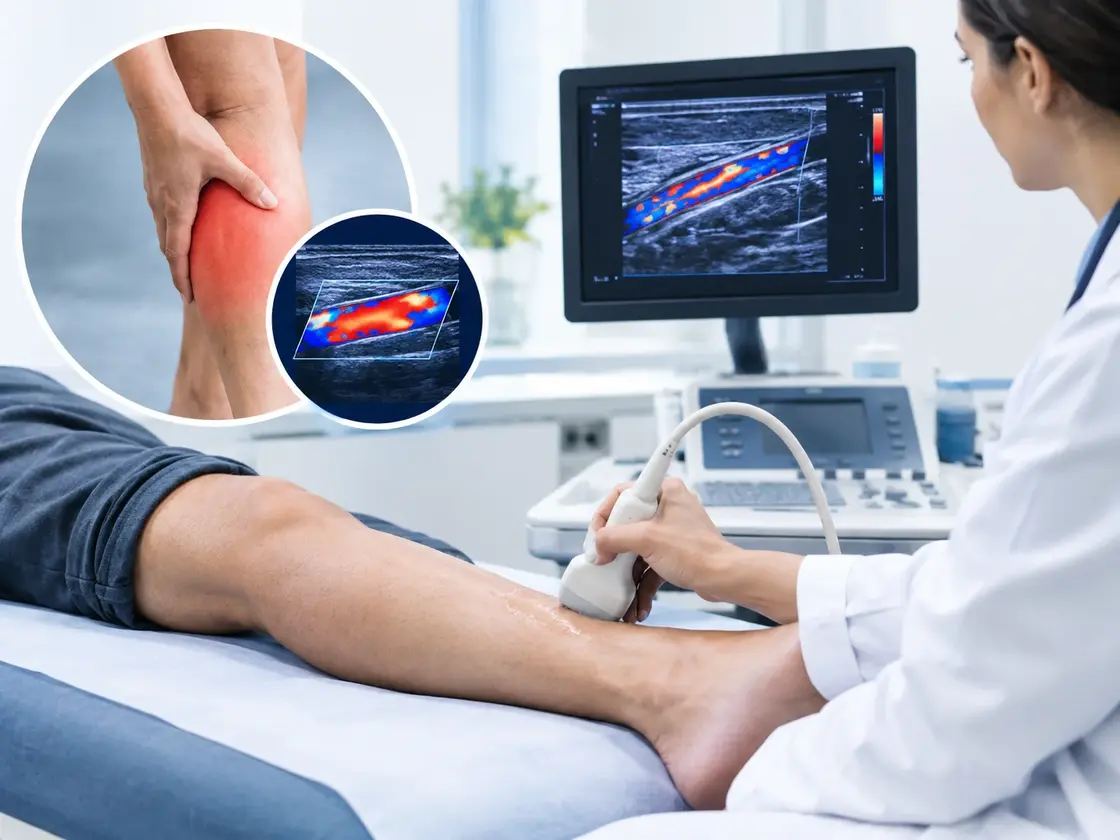
A doctor orders a colour Doppler test in Indore for leg pain or swelling to check whether blood is flowing normally through the veins and arteries in your leg, most often to rule out a blood clot. It’s painless, uses sound waves rather than radiation, and gives an answer in a single sitting. If your leg has been swollen, aching, or heavy for more than a day or two and your doctor has mentioned this test, here’s what it’s actually looking for.
First, a Note on Timing
Most leg swelling is not an emergency. But a small number of cases are, and it’s worth knowing the difference before anything else in this post.
Seek urgent medical care immediately, not a scheduled scan, if leg swelling comes with:
- Sudden shortness of breath or chest pain
- Coughing up blood
- A rapid heartbeat alongside the leg symptoms
These can be signs a clot has moved to the lungs, a pulmonary embolism, which is a medical emergency. For everything else in this post, a Doppler test booked in the next day or two is the right pace.
Why Leg Pain and Swelling Happen
Your legs rely on veins to push blood back up to your heart against gravity, using one-way valves to stop it flowing backward. When that system is working well, you don’t notice it. When it isn’t, blood pools, pressure builds, and you get swelling, aching, or a heavy feeling, usually worse by the end of the day.
Common causes include:
- Deep vein thrombosis (DVT): a blood clot in a deep vein, usually in the calf or thigh
- Chronic venous insufficiency: weakened vein valves that let blood pool over time
- Varicose veins: enlarged, twisted veins close to the skin surface
- Superficial thrombophlebitis: a clot in a vein closer to the skin, less dangerous than DVT but still worth checking
- Reduced arterial blood flow: less common, but can cause pain, especially with walking
A venous Doppler in Indore is the test that tells your doctor which of these, if any, is actually happening, rather than guessing from symptoms alone.
What Makes DVT Different From the Others
DVT gets the most attention because it’s the one that can become dangerous if untreated. A few features that make DVT more likely than a simple muscle strain or general swelling:
- Swelling in one leg only, not both
- Warmth and redness over the affected area
- Pain that worsens when you flex your foot upward
- Swelling that’s new and progressing, rather than a long-standing pattern
- Recent surgery, a long flight or car journey, or prolonged bed rest
None of these confirm DVT on their own, which is exactly why a scan matters more than symptom-guessing here.
One leg swollen and it’s got you worried? A colour Doppler test can confirm or rule out a clot in one visit.
What the Test Actually Checks
Colour Doppler adds movement and direction to a standard ultrasound. Instead of just showing structure, it shows blood flow, its speed, its direction, and whether it’s flowing smoothly or blocked.
For a leg scan, this usually means:
- Checking the deep veins in the calf, behind the knee, and in the thigh for clots
- Confirming whether valves are working properly or letting blood flow backward
- Looking at superficial veins if varicose veins are part of the picture
- Assessing arterial flow if reduced circulation is suspected instead
What Happens During the Appointment
There’s genuinely nothing to prepare for or fear here:
- You lie down, and gel is applied to your leg
- A probe is moved along the leg, sometimes with light pressure to compress the vein and check for a clot
- The whole scan typically takes 20 to 40 minutes, depending on how much of the leg needs checking
- There’s no needle, no radiation, and no recovery time, you can leave and go straight back to your day
If this is your first ultrasound-based test of any kind, our guide on preparing for an ultrasound scan covers the basics that apply here too.
Understanding Your Result
Results generally fall into a few categories:
| Finding | What It Means | Typical Next Step |
| Normal flow, no clot | Swelling likely due to another cause | Doctor investigates further if symptoms persist |
| DVT confirmed | Clot found in a deep vein | Blood thinners, usually started promptly |
| Venous insufficiency | Valves not closing properly | Compression stockings, lifestyle changes |
| Varicose veins | Enlarged superficial veins | Managed based on severity and symptoms |
| Reduced arterial flow | Circulation issue rather than venous | Different treatment path entirely |
A normal result is genuinely useful information too, it rules out the most concerning cause and points your doctor toward other explanations.
Doctor mentioned a Doppler scan and you’re not sure why? We can talk you through what it checks before you book.
Getting a Doppler Ultrasound Done in Indore
If you’ve been searching for Doppler ultrasound Indore after a doctor’s referral, what matters most is getting scanned promptly, DVT is time-sensitive, and delaying a scan by a week to shop around isn’t worth it. Apoorva Diagnostic Centre has been running vascular and general ultrasound in the city for over 35 years, and we’re regularly named among the best diagnostic centre in Indore for colour Doppler specifically, alongside routine sonography and pregnancy scans.
As a full radiology centre in Indore covering both venous and arterial studies, we offer Doppler and vascular imaging at our Vijay Nagar and Sapna Sangeeta branches.
Frequently Asked Questions
1. Is a colour Doppler test painful?
No. It’s a standard ultrasound with light pressure applied at points to check for clots. There’s no needle and no discomfort beyond mild pressure.
2. How urgent is a Doppler scan for suspected DVT?
Fairly urgent. DVT can worsen or, in rare cases, lead to a pulmonary embolism if untreated, so doctors generally want this scanned within a day or two, not weeks later. If you develop sudden chest pain or shortness of breath, seek emergency care immediately rather than waiting for a scheduled scan.
3. Can leg swelling be something other than a blood clot?
Yes, often. Varicose veins, chronic venous insufficiency, and even prolonged standing or sitting can all cause swelling without any clot present. A Doppler test is what actually distinguishes between these.
4. Do I need to prepare for a Doppler ultrasound?
No special preparation is usually needed. Wear loose clothing that allows easy access to your leg, and avoid lotion on the area on the day of your scan.
5. How long does it take to get results?
The scan itself takes 20 to 40 minutes, and your doctor typically receives the report the same day given how time-sensitive a possible clot finding is.
6. Can a Doppler test check both legs at once?
Yes, if your doctor has requested it or if symptoms aren’t clearly limited to one side, both legs can be scanned in the same appointment.
The Bottom Line
Leg pain or swelling that doesn’t settle within a day or two is worth a colour Doppler scan, not because something is necessarily wrong, but because this is the one test that actually tells your doctor whether a clot is involved. It’s quick, painless, and the answer it gives, whichever way it goes, is more useful than waiting and wondering.
Doctor advised a Doppler test? Call 0731 495 2233 to book at Apoorva Diagnostic Centre